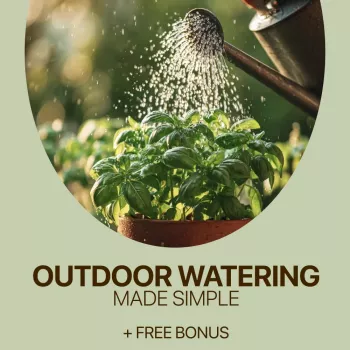
Healthy outdoor plants depend less on “more water” and more on better timing, correct depth, and consistent observation. When watering is dialed in, roots grow deeper, disease pressure drops, and you waste less water to evaporation and runoff. The sections below cover the essentials for outdoor beds, containers, lawns, shrubs, and trees—plus practical methods to adjust for soil type, sun, wind, and seasonal shifts.
Depth matters more than frequency. A light sprinkle only wets the surface, training roots to stay shallow—exactly where heat and wind dry soil fastest. For most outdoor plants, the goal is to wet the active root zone, not just the top inch.
Calendars can’t feel your soil. A simple moisture check prevents most watering mistakes.
Common warning signs help you correct course quickly:
Improving soil structure is a long-term watering upgrade. Building organic matter increases water-holding capacity in sandy soils and improves aggregation and infiltration in heavy soils (see USDA NRCS guidance on soil health and organic matter: https://www.nrcs.usda.gov/conservation-basics/natural-resource-concerns/soils/soil-health).
Different planting setups behave like different “containers,” even in the same yard. Match your approach to how fast the root zone dries and how deep the roots tend to feed.
| Plant type | Typical root zone target | Summer approach | Cool-season approach |
|---|---|---|---|
| Containers (flowers/herbs) | Entire pot depth | Check daily; water thoroughly until drainage | Check every 2–4 days; avoid waterlogged mix |
| Vegetable beds | 6–12 in. | Deep watering 2–4x/week depending on heat/soil; keep moisture steady | 1–2x/week; reduce after rains |
| Established perennials/shrubs | 8–18 in. | Deep soak weekly; increase during heat waves | Every 10–21 days if dry; stop when soil stays moist |
| Young trees (first 1–2 years) | 12–24 in. around dripline | Slow soak 1–2x/week; more in extreme heat | Every 2–4 weeks if dry; avoid soggy soil |
For additional practical watering efficiency ideas, Colorado State University Extension offers a helpful overview: https://extension.colostate.edu/topic-areas/yard-garden/efficient-watering-7-199/.
Watering frequency depends on soil type, sun and wind exposure, plant type, and whether it’s in a container or in-ground. Check moisture 2–3 inches down and water deeply when it’s dry at that depth; in summer, containers may need daily checks while established shrubs may only need a weekly deep soak.
Early morning is usually best because evaporation is lower and leaves have time to dry, reducing fungal risk. Evening watering can work in hot, dry climates if you keep water off foliage and airflow is good, but avoid midday watering when heat and evaporation peak.
Overwatering often shows up as persistently soggy soil, yellowing leaves, wilting despite wet soil, algae on the surface, or fungus gnats in containers. Pause watering, improve drainage (or refresh potting mix), and switch to deeper, less frequent watering based on a soil-moisture check rather than a fixed schedule.












Leave a comment