Speak Up! A Confidence-Building Checklist for Daily Language Practice
Speaking is often the first skill to stall—not because of a lack of knowledge, but because of hesitation, perfectionism, and fear of making mistakes. A simple, repeatable checklist can remove decision fatigue and turn “I should practice” into a daily routine with small, low-pressure wins that compound into real confidence.
What “speaking confidence” really comes from
Speaking confidence isn’t a personality trait—it’s the result of repeatable experiences where your brain learns, “I can handle this.” The fastest way to build it is to make speaking so small and predictable that you actually do it.
- Consistency over intensity: Short, frequent speaking reps beat occasional long sessions because they train recall under mild pressure every day.
- Tolerating mistakes: Confidence rises when errors are treated as data, not failure—each “wrong” moment points to the next mini-skill to practice.
- Automaticity: Repeated phrases and patterns reduce cognitive load during real conversations, freeing attention for meaning and listening.
- Progress signals: Tracking tiny improvements (speed, clarity, comfort) reinforces motivation and reduces the “I’m not improving” feeling.
If you like a clear benchmark for what “proficiency” can look like over time, the ACTFL Proficiency Guidelines help frame progress in practical terms.
Common confidence blockers (and how to reframe them fast)
Most speaking anxiety comes from a few repeating thoughts. Reframing them doesn’t ignore reality—it gives you a more useful target for today’s practice.
- “My accent is bad” → An accent is a normal stage; aim for clarity first, polish later. Clear speech builds trust faster than “perfect” sound.
- “I need more vocabulary” → Use a small set of high-frequency words in many situations. Depth beats breadth when confidence is the goal.
- “I freeze when I speak” → Reduce complexity: shorter sentences, slower pace, more pauses. Pauses are communication, not failure.
- “People will judge me” → Most listeners value effort; proactive self-corrections build trust because they show you care about being understood.
For practical speaking tips and activity ideas, the British Council’s speaking guidance is a solid reference point.
The Speak-Up checklist approach: tiny steps that create momentum
A checklist works because it turns “practice speaking” (vague, intimidating) into a sequence of tiny actions you can complete even on tired days.
- Pre-speak warm-up (30–60 seconds): One breath, one easy sentence, one “starter phrase” (example: “Let me think for a second…”).
- Daily speaking target: Choose a time cap (3, 5, or 10 minutes) to keep it doable and prevent burnout.
- One focus for the day: Pronunciation, past tense, question forms, fillers, or speed—one target keeps your brain from juggling everything at once.
- Short reflection: Note one win and one adjustment for tomorrow to stay objective (and stop over-judging).
Daily speaking practice menu (pick one and start)
Choose the option that feels “almost too easy.” The goal is to show up daily, not to prove anything in a single session. If you’re curious about what “fluency” means in everyday terms, the Cambridge Dictionary definition highlights the core idea: smooth, effective communication.
- Shadowing: Repeat after audio for 2–5 minutes to train rhythm and intonation (don’t pause to analyze—keep moving).
- Micro-monologues: Talk about a familiar topic (day plan, hobby, news headline) for 60–120 seconds.
- Question loops: Ask and answer 5 simple questions aloud to build conversational agility and reduce freezing.
- Role-play scripts: Practice common situations (ordering, introductions, scheduling) with set phrases you can reuse later.
- Message-to-voice: Convert a short text note into an audio note, focusing on clarity and pacing.
Low-pressure daily options by time and difficulty
| Time |
Beginner-friendly option |
Intermediate option |
Confidence cue |
| 3 minutes |
5 questions + short answers |
Shadow 1 short clip twice |
Aim for “clear,” not “perfect.” |
| 5 minutes |
Micro-monologue: daily routine |
Role-play: making plans |
Use pauses instead of stopping. |
| 10 minutes |
Script + record once |
Retell a story + add opinions |
Measure progress by comfort level. |
Language learning mindset: making practice feel safe
When practice feels safe, you practice more. And when you practice more, speaking stops feeling like a performance.
- Set a “minimum viable session” so practice continues on busy or low-energy days (even 60 seconds counts).
- Use compassionate constraints: Limit the topic and vocabulary so your brain can speak faster with less searching.
- Switch from evaluation to experimentation: “What happens if I slow down 10%?” produces useful feedback without shame.
- Track evidence of change: Compare old recordings monthly. The difference is usually clearer than it feels day-to-day.
Using a checklist to build a habit (without burning out)
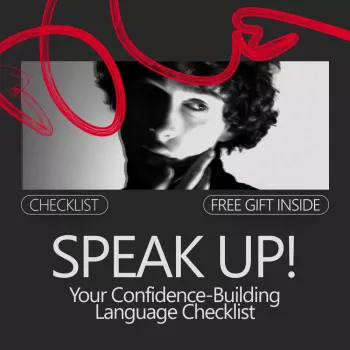
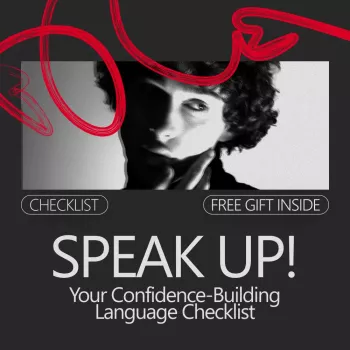
Digital download: Speak Up! Your Confidence-Building Language Checklist
If you want a ready-to-use routine you can repeat without overthinking, Speak Up! Your Confidence-Building Language Checklist (digital download) is designed to reduce hesitation and increase daily speaking reps through simple, low-pressure steps.
More checklists for building better daily routines
Small milestones to celebrate (so confidence keeps growing)
FAQ
How long should daily speaking practice be to build confidence?
Three to ten minutes per day is enough to build confidence when you keep it consistent. Use a time cap, pick one small activity, and gradually add complexity only after the routine feels easy to start.
What if speaking aloud feels embarrassing or awkward at first?
Start privately with recordings, shadowing, or scripts so the discomfort stays low. Awkwardness usually fades as your brain adapts to hearing yourself and retrieving words faster.
Do I need a conversation partner to improve speaking confidence?
A partner helps, but it isn’t required. Solo drills and recordings build speed and clarity, and then occasional real interaction (a tutor session or language exchange) helps you transfer those skills to live conversation.
Recommended for you












Leave a comment