HomeBlogBlog20-Step Startup Launch Checklist: Idea to First Customers

20-Step Startup Launch Checklist: Idea to First Customers

20-Step Startup Launch Checklist: Idea to First Customers

The Entrepreneur’s Launchpad Checklist: A 20-Step Path from Idea to First Customers

Starting a business often fails at the handoff between inspiration and execution. This digital checklist is built for that moment: a clear set of steps that turns a vague concept into a focused offer, a simple launch plan, and measurable traction. Use it as a repeatable workflow for a first startup or a fresh restart after stalled progress.

Who this checklist is for (and what it replaces)

This launch workflow is designed for people who want forward motion without burying themselves in complicated systems.

  • Idea-rich builders who need a concrete next action instead of more brainstorming
  • Side-hustlers balancing limited time, budget, and attention
  • First-time founders who want a lightweight process without complicated frameworks
  • Creators and consultants turning a skill into a paid offer
  • Re-starters who launched once but want a cleaner, more structured second attempt
  • Replaces scattered notes, endless research tabs, and inconsistent to-do lists with a single sequence

If the past pattern has been “learn a lot, build a lot, then hesitate,” this checklist aims to flip it: decide the essentials, validate early, then build only what supports a real launch.

What’s included in the digital download

  • A 20-step checklist designed to move from concept to launch-ready decisions
  • Action prompts that reduce overthinking and force clarity on the essentials
  • A practical flow that prioritizes validation and momentum over perfection
  • A compact format meant to be reviewed weekly or used as a sprint plan
  • Works for product-based, service-based, and digital-first startups

At-a-glance: how the 20 steps support a real launch

Launch focus What gets decided Why it matters
Direction Problem, audience, and outcomes Prevents building the wrong thing for the wrong people
Offer Value proposition, pricing logic, and delivery method Turns an idea into something that can be purchased
Proof Simple validation signals and feedback loops Reduces risk before investing heavily
Build Minimum viable assets and setup Gets to a usable first version faster
Launch Channels, messaging, and a short plan Creates a clear path to first customers
Improve Metrics, iteration, and next milestones Builds compounding progress instead of one-off bursts

The 20 steps, grouped into four sprints

Rather than treating launch like one giant event, the checklist breaks it into four short sprints. Each sprint ends with a decision you can act on immediately.

Sprint 1: Clarity & constraints (get direction on one page)

  • Sprint 1 — Clarity: define the customer, the problem, and the promise in one page
  • Sprint 1 — Constraints: set time, budget, and tools to avoid scope creep
  • Sprint 1 — Differentiation: identify a simple angle (speed, simplicity, niche focus, or outcome)

Sprint 2: Offer & messaging (make it purchasable)

  • Sprint 2 — Offer: choose a deliverable that can be shipped quickly (service package, template, digital product, or starter bundle)
  • Sprint 2 — Pricing: pick a starter price, a rationale, and a clear boundary (what’s included/what’s not)
  • Sprint 2 — Messaging: write a plain-language description that a customer can repeat accurately

Sprint 3: Validation & proof (reduce risk before you build more)

  • Sprint 3 — Validation: run a small test (conversations, waitlist, pre-order, or pilot clients)
  • Sprint 3 — Feedback: collect objections and refine the offer in a controlled way
  • Sprint 3 — Proof assets: gather early testimonials, before/after notes, or case snapshots where possible

Sprint 4: Launch execution (get to first customers)

  • Sprint 4 — Launch prep: assemble the minimum set of pages and materials needed to sell
  • Sprint 4 — Distribution: pick 1–2 channels for initial outreach to keep effort concentrated
  • Sprint 4 — Launch plan: schedule a short, realistic sequence of actions for a 7–14 day push
  • Sprint 4 — Review: track a small set of metrics and decide the next improvement cycle

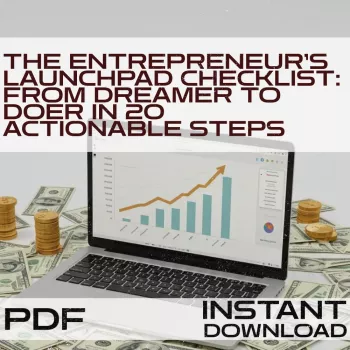
If you want a ready-to-use version of this workflow, use The Entrepreneur’s Launchpad Checklist: From Dreamer to Doer in 20 Actionable Steps to keep decisions in one place and avoid restarting from scratch each week.

How to use the checklist without getting stuck

Common launch blockers—and the step that clears each one

This approach aligns well with the idea of structured experimentation: learn quickly with small tests instead of betting months on unvalidated assumptions (see Harvard Business Review on business experimentation).

A simple weekly cadence for ongoing progress

If you’re also building digital downloads, this cadence pairs well with shipping a first “starter version” and improving it based on buyer questions. Examples of digital-first formats include guides and bundles like When Your Skin Packs Extra Baggage After a Trip – Digital Skincare Guide or a curated bundle like Minimal Trends Toolkit for Outfit Planning: 3-in-1 Bundle of Guides, eBooks & Checklists—the same launch mechanics apply even when the topic changes.

Product details and quick start

For additional foundational guidance on setting up and operating a small business, the U.S. Small Business Administration Business Guide is a solid reference to keep in your bookmarks.

FAQ

Is this checklist useful if the business idea isn’t fully defined yet?

Yes. The early steps are designed to shape a rough idea into a specific audience, problem, and promise so the offer can be tested quickly.

How long does it take to work through the 20 steps?

Many users can complete a first pass in 1–2 weeks with focused daily sessions; a second pass is often used to refine after initial feedback.

Does it work for service businesses as well as product startups?

Yes. The steps focus on defining an offer, validating demand, and building minimum viable assets—applicable to services, digital products, and hybrid models.

Was this article helpful?

Yes No
Leave a comment
Top

Shopping cart

×