
Burnout rarely shows up all at once—it builds through sustained stress, blurred boundaries, and recovery that never quite happens. The goal isn’t to “push through,” but to stabilize energy, reduce overload, and rebuild daily capacity in small, repeatable steps. This guide-style overview maps common burnout patterns and a realistic reset plan that supports rest, focus, and sustainable momentum—without requiring a full life overhaul.
Burnout is widely recognized as a work-related phenomenon connected to chronic stress that hasn’t been successfully managed (see the World Health Organization definition). If you’re feeling stuck, that framing helps: the fix is rarely “more willpower,” and more often a better system for load, recovery, and control.
Burnout can feel confusing because it shows up across emotions, thinking, the body, and behavior—sometimes all at once, sometimes in rotating waves.
Rest helps, but rest alone may not fix it if the stressors and patterns remain unchanged. When your nervous system stays in “on” mode, downtime can become low-quality recovery—lots of stopping, not much restoring. The American Psychological Association highlights how workplace factors and ongoing demands can keep burnout cycles alive, even when someone is technically “off the clock.”
Before you overhaul routines, clarify what you’re actually dealing with. Burnout often clusters into one (or a mix) of these patterns:
A useful starting question: “What would make tomorrow 10% easier?” Then implement one change, not ten.
| Pattern | Common clues | First-step reset | What to avoid |
|---|---|---|---|
| Overload | Packed schedule, constant urgency, missed meals | Remove 1 commitment or shorten 1 meeting | Adding productivity tools that increase maintenance |
| Depletion | Poor sleep, body heaviness, frequent headaches | Set a fixed wind-down time + hydration plan | High-intensity workouts to “force energy” |
| Disengagement | Cynicism, detachment, doing the minimum | Clarify 1 boundary + one meaningful task | Quitting impulsively without a support plan |
| Mixed | All of the above on different days | Stabilize basics (sleep/food/light/movement) first | Trying to solve everything with one big decision |
This is designed to be small enough to repeat. If you miss a day, restart where you are—consistency beats intensity (a point echoed in occupational stress guidance like NIOSH resources on stress at work).
Burnout recovery tends to stick when it’s anchored to a few flexible routines rather than a perfect timetable.
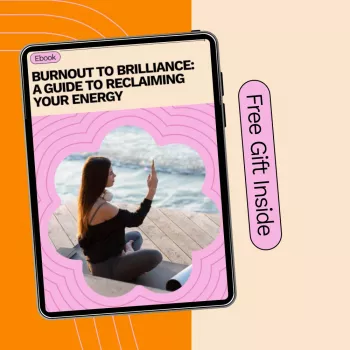
If you want a structured reset, consider Burnout to Brilliance: A Guide to Reclaiming Your Energy (digital download). Look for prompts that help identify stressors, boundary gaps, and recovery habits—plus simple daily routines that don’t require perfection.
A movement guide is often most helpful when it emphasizes ease, range of motion, and recovery rather than “pushing.” For a supportive, low-friction approach, explore Mastering Mobility & Flexibility for Peak Performance.
Recovery varies by severity and how long stress has been sustained. Early-stage burnout may improve in weeks with reduced load and consistent recovery, while deeper burnout can take months—start by stabilizing sleep, boundaries, and daily recovery habits.
Make one change that reduces demands (drop or defer one commitment) and one change that increases recovery (a fixed wake time or a simple wind-down routine). Keep it small enough to repeat daily even on hard days.
They can overlap but aren’t identical. Burnout is commonly tied to chronic stress and exhaustion, while depression and anxiety are clinical conditions with broader patterns; if symptoms are intense, persistent, or include hopelessness or self-harm thoughts, seek professional help promptly.












Leave a comment